
For cat-raising families, ticks are a potential hazard that is easily underestimated — many owners mistakenly believe that “indoor cats do not need protection” and “ticks only appear in summer”, but they do not know that these perceptions may bring life-threatening risks to their beloved cats’ health. As parasitic arthropods, ticks feed on cats’ blood, which not only causes skin irritation and anemia, but more dangerously, carries a variety of pathogenic bacteria and causes fatal infectious diseases. What is more alarming is that the transmission path of ticks is hidden. Even if cats never go out, they may be infected through human clothes, other pets, gaps in home furnishings and other channels. This article will provide shovelers with a comprehensive and scientific annual tick prevention guide for cats from multiple dimensions such as tick hazards, prevention plans, product selection and environmental prevention and control, helping you build a solid health defense line for your beloved cat.

Tick Transmission Paths and Analysis of Cats’ Infection Risks
Ticks have a wide range of activities and flexible transmission methods. Whether cats are raised indoors or outdoors, they are at risk of infection. Their main transmission paths can be divided into three categories, which shovelers need to be alert to:
First, “human-borne transmission”, which is the most important way for indoor cats to be infected with ticks. Ticks often inhabit outdoor environments such as grasslands, woods and bushes. When humans go out for walks, gardening and camping, ticks will attach to clothes and shoes, be quietly brought into the home, and then transfer to cats. Second, “pet cross-transmission”. If there are also dogs in the family, dogs may carry ticks after going out. When interacting with cats, ticks will migrate from dogs to cats. Even if dogs are regularly dewormed, there may be fish that slip through the net. Finally, “environmental invasion transmission”. Ticks are tiny and can drill into the room through gaps in the house foundation, door and window gaps, vents, etc. Especially in the seasons of autumn leaf accumulation and spring vegetation recovery, the probability of such invasion will increase significantly.
In addition, ticks have extremely strong reproductive capacity. A single female tick can lay more than 3,000 eggs at a time. Once a tick appears in the home and is not removed in time, it may cause a large-scale infestation in a short period of time, bringing double threats to the health of cats and their families — some tick-borne diseases can be zoonotic. Protecting cats is also protecting the health of the whole family.
Tick-Borne Diseases in Cats and Their Hazards
Ticks are not just “blood-sucking parasites”. Their saliva may carry a variety of pathogenic bacteria and parasites. After biting cats, they will transmit pathogens into cats’ bodies, causing a variety of serious diseases. Some diseases can lead to cat disability or even death. The common tick-borne diseases are mainly the following three:
(1) Feline Intracellular Parasitosis
This is one of the most harmful tick-borne diseases to cats. Caused by intracellular parasite infection, the clinical manifestations include persistent fever, listlessness, loss of appetite, difficulty breathing, sudden weight loss, etc. In severe cases, it can lead to cat organ failure with extremely high mortality. The treatment of this disease is difficult and costly, and some cats will have chronic respiratory problems after recovery, affecting their lifelong health.
(2) Tularemia
Also known as rabbit fever, it is caused by infection with Francisella tularensis. The main manifestations are swollen lymph nodes, oral ulcers, fever, vomiting and other symptoms in cats. If not treated in time, it will cause systemic infection, and long-term use of antibiotics is needed to control the condition, bringing great pain to cats. During the treatment period, the cat’s immunity will decrease significantly, making it easy to develop other diseases.
(3) Lyme Disease
Caused by infection with Borrelia burgdorferi, the initial symptoms are joint pain, fever and loss of appetite. Cats will show lameness, reduced activity and other manifestations; if not intervened in time, the condition will gradually become chronic, damaging the cat’s joints, kidneys and nervous system, leading to sequelae such as joint stiffness and renal function decline, and even affecting the cat’s normal walking and self-care ability.
Cat Tick Prevention Plans: Choose More Effectively According to Your Needs
The core of cat tick prevention is “annual protection and multi-dimensional prevention and control”. At present, the mainstream prevention methods on the market are mainly divided into three categories: external anthelmintics, tick collars and oral anthelmintics. Each method has its own advantages and disadvantages. Shovelers need to choose the most suitable plan according to the cat’s age, weight, lifestyle and health status. There is no need to blindly pursue the “most expensive” — the one suitable for their own cat is the best.
(1) External Anthelmintics: Wide Applicability and Comprehensive Protection
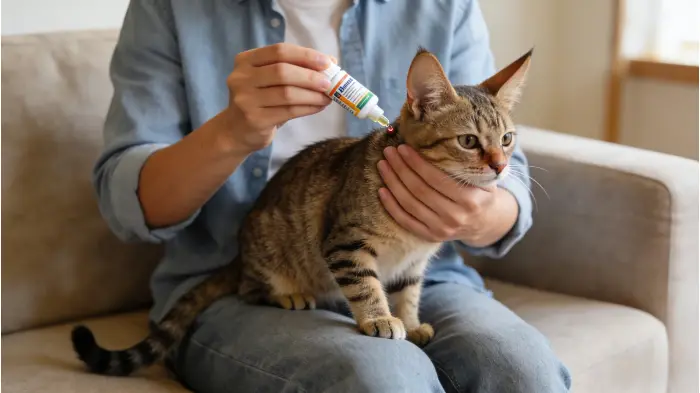
External anthelmintics are currently the most mainstream tick prevention method. When using, the liquid medicine needs to be applied to the skin between the cat’s shoulder blades (where the cat cannot lick), and the liquid medicine will penetrate into the skin’s oil layer to form a protective film, which continuously exerts the anthelmintic effect. Its advantage is that it is applicable to a wide range of cats. It can be used for kittens, adult cats and pregnant cats (some products), and has stable protective effect, which can effectively kill ticks attached to cats.
Precautions for use: Do not bathe the cat within 48 hours before and after application, so as not to dilute the liquid medicine and affect the protective effect; if there are multiple cats in the family, they need to be temporarily isolated after application to avoid cats licking each other’s liquid medicine and causing poisoning.
(2) Tick Collars: Long-Acting and Convenient, Suitable for Busy Shovelers
Tick collars continuously release anthelmintic ingredients to form a protective circle, protecting the cat’s whole body from tick infestation. Its biggest advantage is long-acting and convenient. A high-quality tick collar can provide protection for up to 8 months, no need for monthly operation, suitable for busy shovelers who are easy to forget regular deworming. In addition, most tick collars can adjust the size to adapt to cats of different sizes, and have a waterproof design, which does not affect the cat’s bathing and playing with water.
Precautions for use: Adjust the tightness when wearing to ensure that two fingers can be easily inserted. Too tight may compress the cat’s neck and cause skin irritation, while too loose cannot play a protective role; check the collar for damage and looseness every week. If the cat has skin itching, redness and swelling and other allergic reactions, remove the collar immediately and clean the cat’s neck skin.
(3) Oral Anthelmintics: Good Palatability, Suitable for Cats Who Do Not Like to Be Touched
Oral anthelmintics are mostly in the form of chewable tablets with good palatability (similar to snacks), which are easy for cats to take actively. Its mechanism of action is to absorb the drug ingredients through the intestines and then spread them to the whole body to kill ticks inside and outside the body. Its advantage is convenient to use, no need to forcibly restrain the cat to apply liquid medicine, suitable for cats with sensitive personality who do not like to be touched; at the same time, oral anthelmintics will not leave liquid medicine on the cat’s skin surface, avoiding the risk of poisoning caused by cats licking each other in multi-cat families.
Precautions for use: Strictly determine the dosage according to the cat’s weight, do not take excessive dosage; some oral anthelmintics may cause mild vomiting, diarrhea and other gastrointestinal reactions in cats. If the reaction lasts more than 24 hours, consult a veterinarian in time.
Detailed Explanation and Purchasing Suggestions of Mainstream Tick Prevention Products

There are a wide variety of cat tick prevention products on the market with uneven quality. When purchasing, shovelers should give priority to products produced by regular manufacturers, recommended by veterinarians and with clear test reports, so as to avoid buying inferior products that harm cats’ health. The following is a detailed explanation of mainstream products that have been verified by the market and have a good reputation.